HISTORICAL RESUME
Vitamins have a back-dated history. The dreaded disease scurvy was one of the prevalent diseases in Europe during 15th and 16th centuries. The disease is said to have afflicted the crusadors. Scurvy was reported by Vasco de Gama during his sea voyages and Jacques Cartier in 1535 had reported death of about 25% of his sailing crew due to scurvy. On the recommendation of Sir James Lancaster, an English privateer, the ships of East India Company in 1601 carried oranges and lemons to prevent scurvy. In 1757, James Lind,
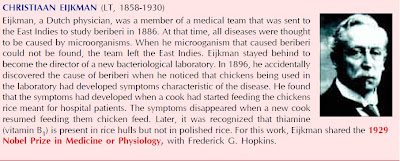 a British naval surgeon, stated that fresh fruits and vegetables alone are effective to protect the body from various maladies and urged the inclusion of lemon juice in the diet of sailors to prevent scurvy. And some 40 years later, the Admiralty took his advice. After limes were substituted for lemons in 1865, British sailors began to be known as “limeys.” Similarly, rickets was also attributed to faulty diets and Guérin (1838) produced it experimentally in puppies to prove the dietary connection. In 1887, Admiral Takaki, Director-General of the Medical Services in Japan, demonstrated that another scourge beriberi could be prevented by enriching the diet with meat, vegetables and milk and at the same time decreasing the amount of milled rice in the case of Japanese sailors. Later, Eijkman (1897), a Dutch physician, found that experimental beriberi could be induced in hens when fed with polished rice without bran. Such hens could be cured by giving them the rice polishings. Eijkmann, for a time, believed that the rice polishings contained something that neutralized the beriberi toxin in the polished rice. In 1906,
  however, Frederick Gowland Hopkins ascribed the diseases such as scurvy and rickets to the lack of some ‘dietary factors’. Six years later (i.e., in 1912), Hopkins in collaboration with Casimer Funk of Poland, who was working at the Lister Institute of London, suggested the vitamin theory which postulates that ‘specific diseases such as beriberi, scurvy and rickets are each caused by
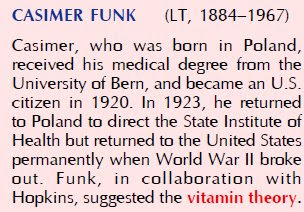 the absence from the diet of a particular nutritional factor.’ Funk, for the first time, also isolated the dietary factor from rice polishings which acted as antiberiberi substance. Since this factor was an amine and necessary to life, Funk at the suggestion of Dr. Max Nierenstein introduced the term ‘vitamine’ (vitaL = life) to denote it. Since subsequent studies showed that not all these substances are amines, the terminal letter ‘e’ was dropped from its spelling at the suggestion of Sir. J.C. Drummond (1919), who also proposed their alphabetical nomenclature. In fact, the various vitamins have no structural resemblance to each other, but because of a similar general function in metabolism, they are studied together. Although these molecules serve nearly the same roles in all forms of life, but higher animals have lost the capacity to synthesize them.
a British naval surgeon, stated that fresh fruits and vegetables alone are effective to protect the body from various maladies and urged the inclusion of lemon juice in the diet of sailors to prevent scurvy. And some 40 years later, the Admiralty took his advice. After limes were substituted for lemons in 1865, British sailors began to be known as “limeys.” Similarly, rickets was also attributed to faulty diets and Guérin (1838) produced it experimentally in puppies to prove the dietary connection. In 1887, Admiral Takaki, Director-General of the Medical Services in Japan, demonstrated that another scourge beriberi could be prevented by enriching the diet with meat, vegetables and milk and at the same time decreasing the amount of milled rice in the case of Japanese sailors. Later, Eijkman (1897), a Dutch physician, found that experimental beriberi could be induced in hens when fed with polished rice without bran. Such hens could be cured by giving them the rice polishings. Eijkmann, for a time, believed that the rice polishings contained something that neutralized the beriberi toxin in the polished rice. In 1906,  however, Frederick Gowland Hopkins ascribed the diseases such as scurvy and rickets to the lack of some ‘dietary factors’. Six years later (i.e., in 1912), Hopkins in collaboration with Casimer Funk of Poland, who was working at the Lister Institute of London, suggested the vitamin theory which postulates that ‘specific diseases such as beriberi, scurvy and rickets are each caused by
 the absence from the diet of a particular nutritional factor.’ Funk, for the first time, also isolated the dietary factor from rice polishings which acted as antiberiberi substance. Since this factor was an amine and necessary to life, Funk at the suggestion of Dr. Max Nierenstein introduced the term ‘vitamine’ (vitaL = life) to denote it. Since subsequent studies showed that not all these substances are amines, the terminal letter ‘e’ was dropped from its spelling at the suggestion of Sir. J.C. Drummond (1919), who also proposed their alphabetical nomenclature. In fact, the various vitamins have no structural resemblance to each other, but because of a similar general function in metabolism, they are studied together. Although these molecules serve nearly the same roles in all forms of life, but higher animals have lost the capacity to synthesize them.


